
The Lagos International Trade Fair opens at Tafawa Balewa Square on 6 November and runs for ten days, per the dates listed at the time of writing — confirm them with the organiser. Somewhere in that hall, a rep is about to ask four hundred strangers for their phone number with nothing to offer in return.
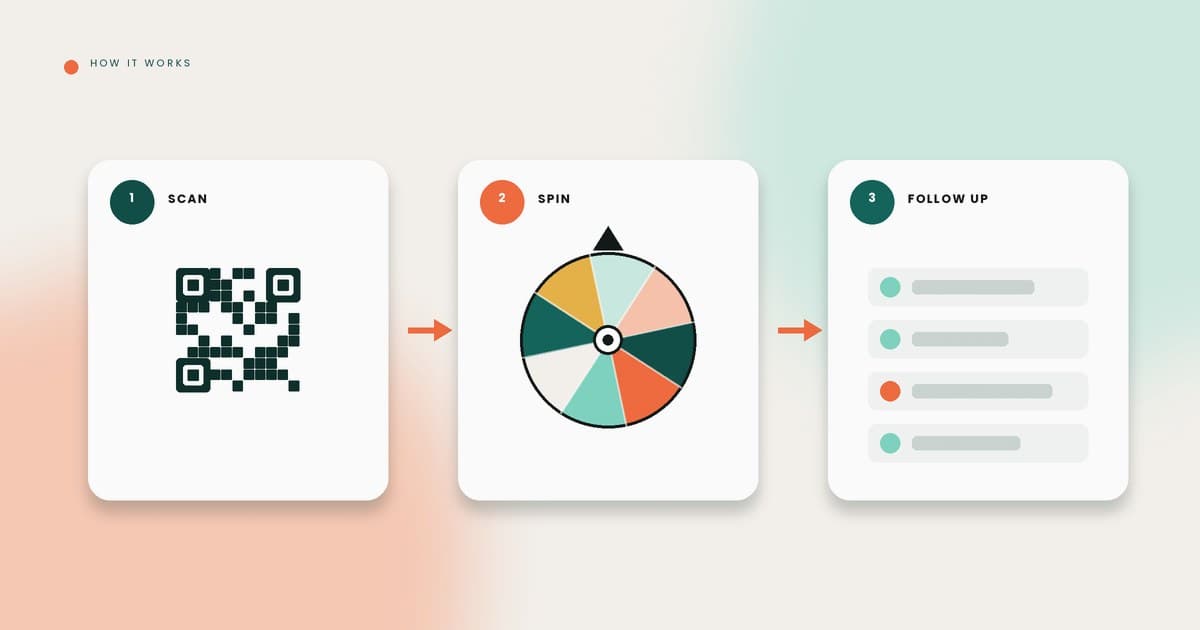
Trade Shop exists for that specific thirty seconds. A visitor scans a code, gives you their details, spins your wheel and wins something. You leave the fair with a list instead of a bowl.
Here is the whole thing, from both sides.
What the visitor experiences
They see the code. A QR code on your fascia, on the counter, on a table talker or on the rep's badge. It has to be big enough to scan from arm's length and low enough that a person can reach it without leaning over your table.
They scan it with their own phone. Native camera app, no download, no store, no permission dialogue. This matters more than it sounds. Ask a stranger to install an app at a fair and you lose almost all of them; the phone browser is the only distribution channel that works on a crowded floor.
They fill in their details. Name and phone, with email depending on campaign settings. They type it themselves on their own keyboard, which is why the email is spelled correctly — the single biggest advantage over anything handwritten, as we covered in Trade Shop vs paper forms. The current form has no dedicated marketing-consent field.
Then the wheel spins. Details are captured before the wheel turns, not after. That ordering is the entire product. If the spin came first, everybody would spin and half would walk away before typing anything.
They win, and they see it immediately. The segment lands, the prize is named on their screen, and your rep hands it over. Instant, visible, on the spot — which is what makes it an incentive rather than a promise about a draw on Friday. Why that works on people is the subject of our post on the psychology of spin-to-win.
The whole loop is under a minute. Six people can do it at once, because each one is holding their own device rather than queuing for your tablet.
The wheel is not the product. The wheel is the reason a stranger is willing to type their number into a phone at a stand they have never heard of.
What the exhibitor sees
Campaign setup. A campaign is one event. You give it a name and dates, brand the experience, define the wheel segments, and generate the QR code you will print. You can build it days ahead and leave it as a draft until the fair opens.
Prize rules and limits. Each segment gets a prize, a limit and a probability. The limit is a hard cap — five hampers means five, and when they are gone the segment stops paying out. The probability is what stops the good item leaving at 10:20am on day one of a ten-day fair. This is the setting most first-time users under-think, and our prize wheel guide walks through how to weight it so you attract buyers rather than freebie hunters.
A live dashboard. Lead records and spin outcomes update as the fair runs. Review campaign totals and daily engagement trends to see how participation changes. Those are the numbers we argue for in Foot traffic is a vanity metric.
Participant records. Every entry, timestamped, with what they entered and what they spun. Exportable, so the list is in your hands and not locked in a dashboard.
Campaign history. Active, completed and draft campaigns sit together, so the fair you ran in September is still there when you plan November's. If you exhibit at several events a year, that history is how you tell which floor was worth the booth fee.
What Trade Shop is not
Worth being blunt, because a misjudged expectation is a bad first fair.
Trade Shop is a booth lead-capture experience. It is not a CRM. There are no CRM integrations, no API, no team seats, no badge scanning, no offline mode, and no built-in SMS, email or WhatsApp automation. Nothing sends itself.
What that means practically: you export the participant records and follow up from whatever you already use — your CRM, your mail tool, or your rep's WhatsApp. Trade Show PRO's 2026 round-up reports that companies contacting leads within 24 hours are six to nine times more likely to convert than those who delay, and that up to 80% of trade show leads never receive any follow-up at all. Trade Shop gets you a clean list on the night. Sending the message is still your job, and our 72-hour follow-up plan is how we would do it.
It also needs a live connection, on the visitor's phone. There is no offline mode. Keep a paper pad under the table for the twenty minutes when the network dies, and enter those the same evening.
On consent: Trade Shop currently has no dedicated marketing-consent field. The Nigeria Data Protection Act requires consent for direct marketing to be freely given, specific, informed and affirmative, and pre-ticked boxes do not count. See Is your booth raffle legal?. Not legal advice.
Setting one up before your next fair
| When | What to do |
|---|---|
| A week out | Create the campaign and set your wheel segments and prize limits |
| Five days out | Send the QR to print — on the fascia, on two table talkers, and on a card in each rep's pocket |
| Two days out | Scan it yourself on three different phones. Fill the form. Spin it. Fix what annoys you |
| The night before | Buy the prizes and count them against your limits. Brief the reps on the one-line opener |
| Day one, lunchtime | Open the dashboard. Review leads and spins, then adjust your pitch if needed |
| Every evening | Export the day's records and start the follow-up while the conversation is fresh |
The step people skip is testing it on somebody else's phone. Do it. Ten minutes on a Tuesday saves a broken morning at the stand.
What ₦10,000 covers for up to 3 days
Priced by campaign duration. That includes the branded spin experience, QR access, prize rules and participant records — the campaign, the wheel, the code, the dashboard and the export.
There is no seat count, no monthly commitment, no annual contract and no per-lead charge. A ten-day fair costs ₦17,000, while a one-day event costs ₦10,000. For context on how that sits against the alternatives, we compared it with enterprise lead retrieval tools, where the published pricing runs per seat, per month, in dollars.
The prizes themselves are yours to buy. That is usually the bigger line, and it should be — the wheel only works if what is on it is worth stopping for.
Frequently asked questions
Do visitors need to download an app to spin the wheel?
No. They scan the QR with their normal camera and everything runs in the phone browser — form, spin and prize. Nothing to install, which is the only way this works with strangers on a busy floor.
Are the leads captured before or after the spin?
Before. The visitor enters their details first and the wheel spins afterwards, so you keep the record whether or not they win anything worth having.
Can I control which prizes get won?
Yes, within limits you set. Each prize has a cap on how many can go out and a controlled probability, so the expensive item stays rare across the full run of the fair.
Does Trade Shop send follow-up messages to my leads?
No. There is no SMS, email or WhatsApp automation. You export the participant records and send from your own tools, ideally within 24 hours.
Set your wheel up before the next fair
If you have a booth booked, the campaign takes an evening to build and the QR takes a day to print. Do it before the crates are packed, not on the morning of day one. Launch a campaign — from ₦10,000 for up to 3 days, plus ₦1,000 per extra day. Questions go to hello@usetradeshop.com or WhatsApp +234 806 781 8198.
Sources: Trade Show PRO — Trade Show Statistics 2026: 50+ Data Points Every Exhibitor Should Know · Lagos International Trade Fair — official site · Nigeria Data Protection Commission