
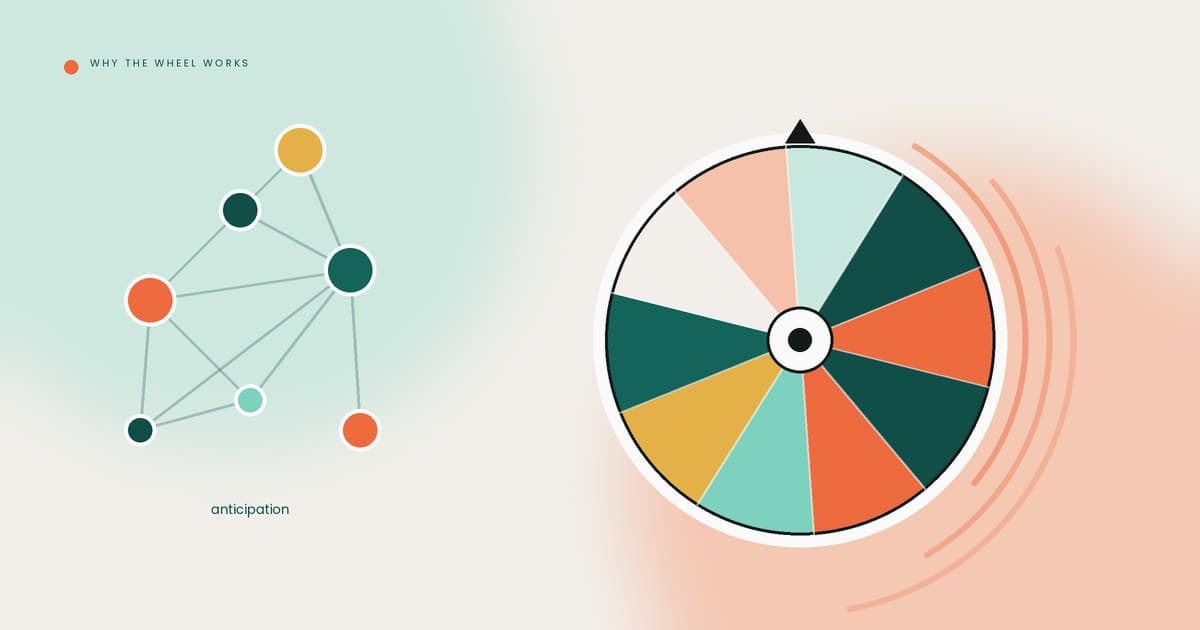
Stand at the end of an aisle at any Lagos fair and watch which booths people slow down for. It is not the ones with the best product. It is the ones where something is visibly happening.
The prize wheel is the cheapest way to make something visibly happen. It also gets described in a lot of confident, unsourced blog copy about "dopamine loops".
Some of the psychology is real and well evidenced. Some of it is folklore that got repeated until it sounded like research. Worth separating the two, because the design decisions follow from which is which.
An unfinished action pulls harder than a finished one
The Zeigarnik effect is the idea that an interrupted or incomplete task occupies attention more than a completed one. A wheel that is visible but unspun is an unfinished action sitting in front of a stranger. The pull is not "I want a branded power bank." It is closer to "that thing is not resolved yet."
Honest caveat: Zeigarnik is one of those early-twentieth-century findings whose popular version travelled much further than its replication record. Treat it as a useful frame for why an unstarted wheel is more magnetic than a table of flyers, not as a law you can bank on.
The practical version is uncontroversial regardless: a booth with an obvious, incomplete, five-second action beats a booth with no action. Trade Show PRO's 2026 statistics round-up reports that booths with interactive demos see 2–3x longer engagement than those without, and that the average attendee spends only 5–8 minutes at a typical booth. Doubling a five-minute window is the whole game.
Why a spin beats handing out the same pen
Give everyone a branded pen and you have a transaction. Make them spin for it and you have an event, even when the expected value is identical.
The mechanism is variable reward. Uncertain outcomes hold attention differently from fixed ones, and the behavioural science on variable-ratio schedules is genuinely deep.
Now the honest part. Almost all of that literature concerns repeated behaviour over many trials: the slot machine, the feed, the notification. Your visitor spins once. Applying schedule-of-reinforcement research to a single pull is an extrapolation, and anyone telling you a booth wheel "hijacks the dopamine system" is selling something.
What survives the caveat is smaller but still useful. Uncertainty makes a small prize feel like an outcome rather than a handout, and an outcome is worth watching and worth mentioning to the person you came with. That is enough.
The wheel does not persuade anybody to buy. It buys you ninety seconds of attention from someone who was going to walk past.
Reciprocity, and why it works backwards here
Reciprocity is the sturdiest thing in this whole post. People who receive something feel a pull to give something back, and it is one of the better-supported findings in the persuasion literature, though most of the studies behind it are small and none of them were run on a Nigerian fair floor.
Except a well-built booth wheel does not use classic reciprocity, because the form comes first. On Trade Shop the visitor scans, enters their details, and only then spins. So the sequence is not gift-then-ask. It is promise-then-ask-then-deliver.
That works for a different reason: a visible, immediate, guaranteed-to-resolve payoff makes the ask feel like a fair trade rather than a data grab. Nobody fills in a form for a "we'll be in touch". They will fill one in for a wheel spinning two feet away.
Which is also why the promise has to be honest. If the wheel is rigged to land on "10% off" every time, you have not used reciprocity, you have taught 400 people that your brand fudges. Prize limits and controlled probabilities are for managing stock, not for manufacturing disappointment. How to design a prize wheel that attracts buyers, not freebie hunters covers where that line sits.
Scarcity, loss aversion, and the most abused idea in marketing
Loss aversion — losses looming larger than equivalent gains — is real and well established. A limited prize pool ("three tablets, first come") converts an abstract offer into something a person can lose by walking away.
It is also the mechanism most likely to be faked, and the fake is detectable. A counter that never moves. A "last one" that is still last one three hours later. Nigerian fair-goers are not naive shoppers, and the same person is walking several booths that day and comparing.
Real scarcity works. Announced scarcity that turns out to be false does more damage than none at all, because it is the only claim on your booth a visitor can independently verify.
The crowd is the advertisement
Social proof at a booth is less about persuasion than about signage. Four people standing around a wheel is legible from thirty metres in a way that no banner is. It answers "is anything happening here" before anyone reads a word.
Two honest limits. A crowd of six is proof; a crowd of twenty is a queue, and queues make busy buyers leave. And a crowd says something is happening, not that it is worth having — so if your wheel attracts only students collecting free things, social proof will faithfully advertise that.
There is a second-order effect that gets ignored. Trade Show PRO reports that gamified elements increase booth staff engagement by 35–40%. Standing behind a wheel people walk up to is a materially different job from standing behind a table trying to stop people, and it shows in how your staff open conversations by hour six. How to staff a booth has more on that.
How strong is each mechanism, really
| Mechanism | Evidence | What to do with it |
|---|---|---|
| Unfinished action (Zeigarnik) | Mixed; popular version overstated | Make the wheel visible and obviously unstarted |
| Variable reward | Deep, but built on repeated trials, not single spins | Spin beats flat giveaway; skip the neuroscience talk |
| Reciprocity | Strong and well replicated | Deliver the prize immediately, every time |
| Scarcity / loss aversion | Strong, and the most faked | Only announce limits that are true |
| Social proof | Strong as a signal, weak as an endorsement | Aim for a small crowd, manage the queue |
Frequently asked questions
Does gamification actually increase lead generation at trade shows?
The strongest directly relevant figures are Trade Show PRO's: booths with interactive demos see 2–3x longer engagement, and gamified elements lift booth staff engagement by 35–40%. Both are about attention and behaviour at the booth rather than a guaranteed lift in qualified leads, which still depends on what you ask on the form.
Is a prize wheel better than just giving everyone a gift?
For attention, usually yes — an uncertain outcome is more watchable and more shareable than a handout at the same cost. For lead quality it makes no difference on its own. The prize you choose decides who you attract, not the wheel.
Should the wheel spin before or after collecting details?
After. Details first, spin second. The anticipated payoff is what carries the form, and once someone has their prize the incentive to fill anything in has gone.
Do people mind giving their details for a prize spin?
Far less than they mind a vague newsletter sign-up, because the exchange is explicit and instant. Under the Nigeria Data Protection Act 2023 the consent still has to be specific and informed, which is covered in our NDPA post.
Design for the moment before the wheel
The wheel is not the point. The wheel is the reason a stranger is willing to stand still and type their name into their own phone, which is the only part of the interaction that has value on Monday. Build the form for that moment — short, specific, one qualifying question — and let the wheel do the work of getting somebody to it. Launch a campaign — from ₦10,000 for up to 3 days, plus ₦1,000 per extra day.
Sources: Trade Show PRO — Trade Show Statistics 2026: 50+ Data Points Every Exhibitor Should Know