
Every debrief starts the same way. "It was packed." "We had way more traffic than last year." "The stand was busy the whole time."
None of those are numbers. They are weather reports.
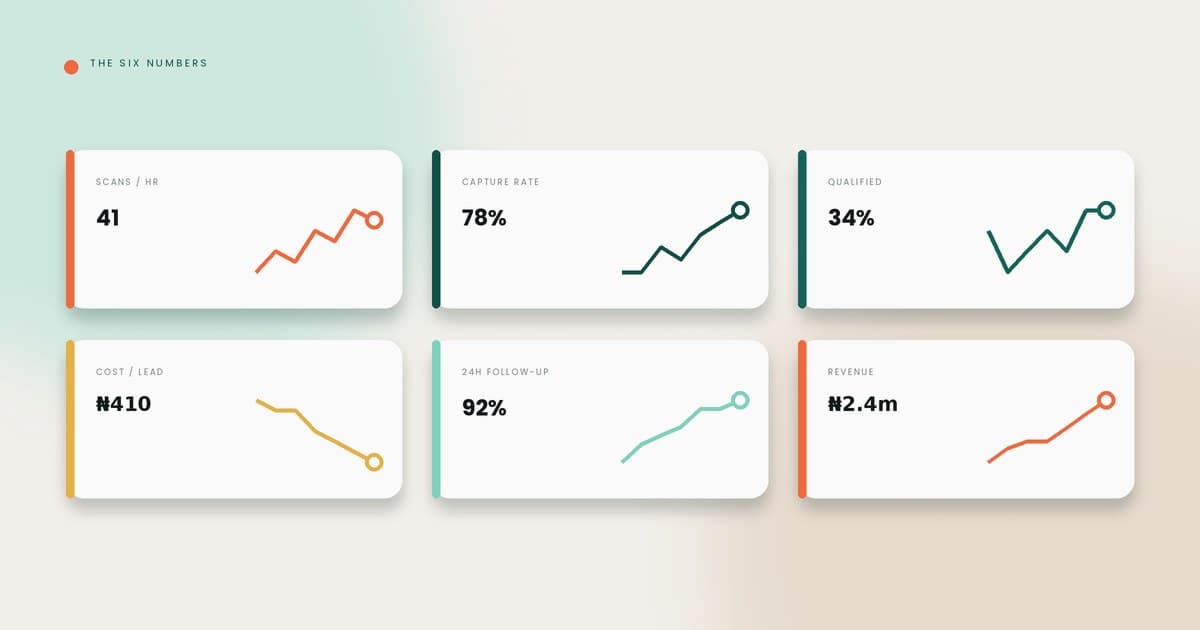
Foot traffic is the easiest thing to notice at a booth and the least useful thing to record, because it measures the fair's marketing, not yours. Here are six numbers that actually move, with the formula for each, what good looks like, how to get it without a data team, and the trap sitting inside it.
Why foot traffic tells you nothing
Trade Show PRO's 2026 statistics round-up reports that attendees visit roughly 5–8 booths a day and spend 5–8 minutes at a typical booth. That is the budget you are competing for: a few slots, a few minutes each.
Traffic past your stand is set by the organiser's gate numbers and your aisle position. You did not earn it and you cannot repeat it. Everything downstream of "a person stopped" is yours.
So measure the funnel, not the crowd.
1. Scans per hour
Formula: total QR scans ÷ hours the booth was open.
What good looks like: there is no published benchmark, so treat it as a self-referencing number. Set your baseline in hour one of day one and compare every hour against it. House rule of thumb: if hour four is below half of hour one, something on the stand has stopped working — usually a person, not the sign.
How to measure it without a data team: your capture tool counts scans automatically. On paper, tally marks on a page taped under the table, cleared hourly.
The trap: it measures your QR signage and your aisle position, not interest. A great scan rate with a poor capture rate means your sign is doing a job your booth cannot finish.
2. Capture rate
Formula: completed lead records ÷ total scans.
What good looks like: my working rule is 60% or better. That is a practitioner's rule of thumb, not a researched benchmark — honestly, your first fair sets your number and you beat it at the next one.
How to measure it: both figures come off the same dashboard. If they do not, that is your first problem.
The trap: a low capture rate is almost never a traffic problem. It is a form problem. Every field you add is a chance to abandon, and someone standing in aisle heat with a bag in one hand will not fill in eight boxes. Under half, cut fields before you cut anything else.
3. Qualified lead rate
Formula: leads meeting your qualification test ÷ total leads.
What good looks like: this varies too much by sector to benchmark, but the discipline is fixed — define "qualified" in writing before the fair opens. One question does it: budget authority, company size, or "when are you buying".
How to measure it: put the qualifying question on the capture form itself. Trade Show PRO reports that lead scoring at the point of capture improves conversion by 38%, and the point of capture is the only moment the answer is free.
A lead you qualify after the fair is a lead you are qualifying from memory, and memory is not a data source.
The trap: counting volume as success. Four hundred unqualified rows and sixty qualified ones are not comparable outcomes, and a prize that attracts the wrong crowd will inflate the first while flattening the second.
4. Cost per lead
Formula: total booth cost ÷ leads captured.
What good looks like: Trade Show PRO puts international trade show lead acquisition at roughly $100–$300 per prospect, against $400–$600 for outbound sales leads. That is a dollar-denominated global figure, so use it as direction rather than a naira target — the point is that fair leads are usually cheaper than outbound, not that a specific number holds in Lagos.
How to measure it: add everything. Space, build, print, staff, transport, power, accommodation. Our breakdown of what exhibiting actually costs in Nigeria has the full line-item list.
The trap: counting only the stand rental, which halves your true cost per lead and makes a mediocre fair look excellent. The second trap is dividing by leads captured rather than leads worked — very different numbers, for reasons covered in the 80% follow-up post.
5. Follow-up rate within 24 hours
Formula: leads personally contacted within 24 hours of capture ÷ total leads.
What good looks like: 100%, and it is achievable, because the constraint is a named owner and a deadline rather than headcount. Trade Show PRO reports that up to 80% of trade show leads never receive any follow-up, and that companies contacting leads within 24 hours are 6–9x more likely to convert than those who delay.
How to measure it: a column in the export, filled in by whoever sent the message.
The trap: counting a bulk blast as contact. One generic email to 400 addresses is not a 100% follow-up rate. If it does not reference the conversation, it is noise. The 72-hour plan sets out what counts.
6. Closed revenue per fair
Formula: revenue from fair-sourced deals closed inside a defined window ÷ total booth cost.
What good looks like: anything above 1.0 pays for the booth. What matters more is fixing the window in advance — 60 days, 90 days, whatever matches your sales cycle — and never moving it afterwards.
How to measure it: tag the source on every deal at creation. If your records cannot answer "where did this customer come from", nothing else on this list will help you.
The trap: attribution amnesia. A deal closing in March from a November lead gets logged as "referral" because nobody remembers the booth, and the fair looks like it failed. That single habit is why exhibitors underrate a channel that worked.
The scorecard
Copy this into a note before the doors open, and fill in one column per fair.
| Metric | Formula | Where the number comes from | Your fair |
|---|---|---|---|
| Scans per hour | Scans ÷ open hours | Dashboard, hourly | |
| Capture rate | Leads ÷ scans | Dashboard | |
| Qualified lead rate | Qualified ÷ total leads | Qualifying question on the form | |
| Cost per lead | Total booth cost ÷ leads | Your full budget sheet | |
| 24h follow-up rate | Contacted in 24h ÷ leads | Column in the export | |
| Closed revenue per fair | Fair-sourced revenue ÷ booth cost | Sales records, fixed window |
Six numbers. Five come from the fair itself and one comes months later, which is exactly why the sixth is the one nobody records.
Frequently asked questions
What is a good ROI for a trade show booth?
Any multiple above 1.0 of total booth cost has paid for the stand, but judge it against your defined attribution window rather than the week after the fair. Set that window before you exhibit — 60 or 90 days is typical — so the result cannot be argued about afterwards.
How do you calculate cost per lead at a trade fair?
Divide total booth cost by leads captured, counting every cost line and not just the stand rental. Trade Show PRO puts international trade show lead acquisition at roughly $100–$300 per prospect against $400–$600 for outbound, useful as direction rather than a naira target.
What is a good booth conversion rate?
There is no reliable published benchmark, and anyone quoting one precisely is guessing. Measure your own capture rate — leads divided by scans — at your first fair and treat it as the number to beat.
How do I track booth metrics without a CRM?
All six can be tracked with a lead capture dashboard, a spreadsheet export and one extra column. The only real requirement is that someone owns the file and fills it in on the day.
Score your next fair properly
Trade Shop records captured leads and spins per campaign — and exports the participant records you need for the rest. No CRM, no integration project, just the file you need on Monday morning. Launch a campaign — from ₦10,000 for up to 3 days, plus ₦1,000 per extra day.
Sources: Trade Show PRO — Trade Show Statistics 2026: 50+ Data Points Every Exhibitor Should Know