
Picture two stands in the same aisle. One puts an iPhone at the top of the wheel and pulls a queue that runs all ten days. The other offers a year of free delivery on wholesale orders and pulls a shorter queue of people who buy wholesale.
The first stand goes home with the bigger number. The second goes home with the better list.
Both wheels work exactly as designed. The prize decides who queues, and a prize anybody would want brings you everybody.
The tradeoff nobody sets deliberately
Prize value and lead quality pull against each other, and most exhibitors only pick one end by accident.
A high-value general prize maximises volume. Phones, generators, cash. Every person at the fair qualifies as someone who wants one, including the six-year-old and the exhibitor from the next aisle. You will hit your scan target and your Monday call list will be worthless.
A prize that only your buyer values maximises quality and costs you volume. Fewer spins, more of them people you can actually sell to.
Use this test on your grand prize: would a person who will never buy from you still queue for it? If yes, you are buying traffic. If no, you are buying leads.
That does not mean the prize has to be boring. Free delivery for a quarter, a month of your service, ₦200,000 of order credit, a stocked starter kit worth more than your average first order. All of those are genuinely exciting to the right person and completely uninteresting to a passer-by.
A prize anybody would want brings you anybody. That is not a giveaway, it is a queue.
Everybody wins something
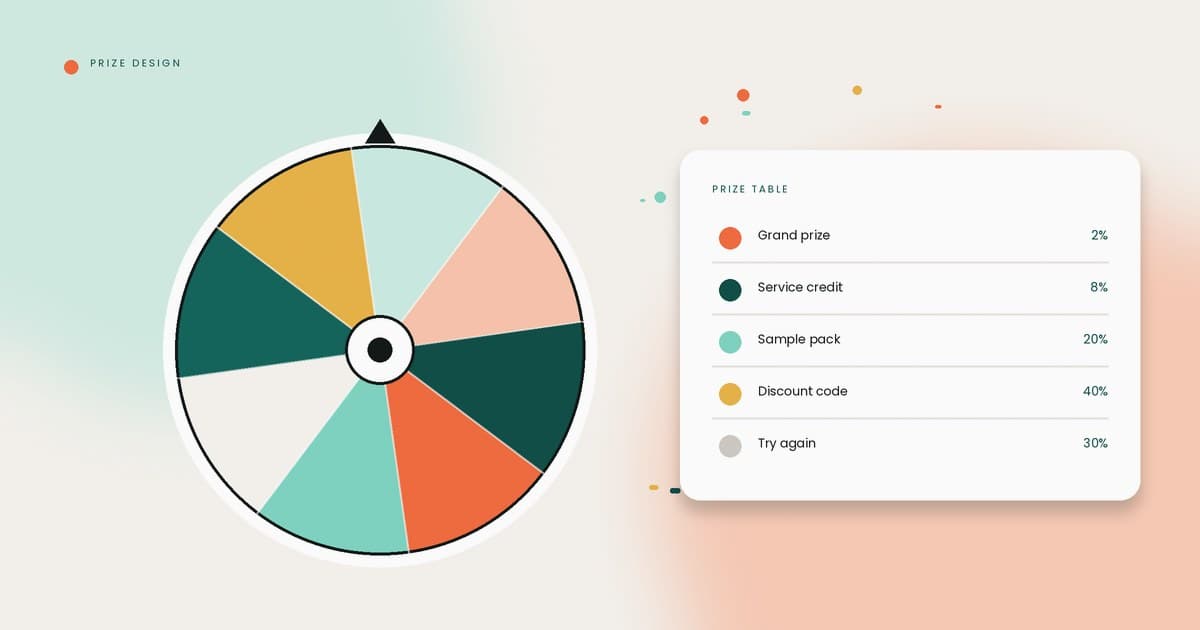
Never put "try again" or "better luck next time" on a wheel. It is the single most common mistake, and it costs you twice.
The visitor has already handed over their phone number by the time the wheel appears. Giving them nothing in return turns a positive interaction into a small resentment, in public, in front of the next three people deciding whether to stop.
The fix is cheap. Make the lowest segments things that cost you almost nothing but carry real value: a discount code with a deadline, a free consultation, a sample, a branded item you already had printed. Everyone walks away holding something and telling the person next to them what they got.
Trade Show PRO's 2026 statistics round-up reports that gamified elements lift booth staff engagement by 35 to 40 per cent, and that booths with interactive demos see two to three times longer engagement. Both of those depend on the wheel producing visible outcomes, not shrugs.
A sample eight-segment wheel
This is a working example for a wholesale food brand with an average first order around ₦120,000. Adapt the values, keep the shape.
| Segment | Prize | Probability | Daily limit |
|---|---|---|---|
| 1 | ₦150,000 order credit (grand prize) | 1% | 1 for the whole fair |
| 2 | Free delivery for 3 months | 4% | 2 per day |
| 3 | ₦10,000 voucher | 10% | 5 per day |
| 4 | ₦5,000 voucher | 15% | 10 per day |
| 5 | Product bundle | 15% | 10 per day |
| 6 | 10% off first order | 20% | No limit |
| 7 | Free stock planning session | 15% | No limit |
| 8 | Branded tote bag | 20% | Stock on hand |
Three things to notice. The probabilities sum to 100 and there is no losing segment. The two segments with real cost sit at 1 and 4 per cent, so across 200 spins you would expect to give away about ten of them in total, and the grand prize roughly twice. And the two zero-marginal-cost segments cover 35 per cent of outcomes, which is what keeps the wheel affordable at volume.
Probability without limits is still dangerous. A 1 per cent grand prize can land on the third spin of day one, and then you have nine days of wheel with nothing at the top. Trade Shop lets you set prize limits alongside controlled probabilities, so the grand prize can be capped at one for the fair regardless of how the odds fall. Set campaign-wide caps on costly prizes, then check the dashboard each evening.
Ideas by industry
| Sector | Grand prize that filters | Low-cost segments that still feel like a win |
|---|---|---|
| Beauty and skincare | Full regimen for 6 months, or a stocking package for a salon owner | Sample sachet set, ₦3,000 off, free skin consultation |
| Fintech and B2B software | 12 months of the paid tier, or waived setup for a merchant account | Extended trial, free onboarding call, branded power bank |
| FMCG and wholesale | Order credit, free delivery for a quarter, a stocked shelf display | Case discount, product bundle, branded crate |
| B2B services (legal, HR, logistics) | A full audit or a month of retainer work | 30-minute advisory session, template pack, priority quote |
| Fashion | A bespoke piece or a wardrobe voucher redeemable in store | Alteration voucher, ₦5,000 off, branded garment bag |
The pattern across all five: the grand prize is your own product at a scale that only makes sense to someone who uses it. The small prizes are things that pull the winner one step closer to buying.
What not to put on a wheel
- Cash. It attracts everyone, tells you nothing, and creates a crowd-control problem at a busy stand.
- Phones, generators and TVs, unless you sell them. You are paying a lot to meet people who want a phone.
- Try again. Covered above. Delete it.
- Anything you cannot hand over or issue on the spot. A prize that requires delivery next month needs an address, a courier budget and someone to chase it. Most exhibitors discover this in week three.
- Prizes with unclear terms. "50% off" with no expiry and no minimum will be presented to you in fourteen months.
- Alcohol at a general-admission fair, where a large share of visitors are minors or would rather not be handed a bottle in public.
Frequently asked questions
What are good prize wheel ideas for a trade fair?
Your own product or service at a scale only a real buyer would want, with small prizes that move people toward a first purchase. Discount codes with deadlines and free consultations cost you almost nothing and still land as wins.
What odds should I set on a spin-to-win wheel?
Keep your expensive segment at 1 to 5 per cent, mid prizes around 10 to 15 per cent each, and cheap or zero-cost prizes covering at least a third of the wheel. Then cap the costly ones with hard limits so the odds cannot bankrupt you on day one.
Should everyone win something on a prize wheel?
Yes. The visitor already gave you their details before spinning, so a losing segment breaks the exchange in front of an audience. Make the lowest tier cheap rather than empty.
How do I stop freebie hunters at my booth?
Change the prize, not the process. A grand prize that only makes sense to a buyer thins the queue and improves everything downstream, including your follow-up.
Build the wheel before you print the standee
Trade Shop lets you set your segments, controlled probabilities and prize limits in advance, capture the lead before the wheel spins, and watch spin outcomes and lead records land in one dashboard. Review the prize stock as the event continues.
Launch a campaign — from ₦10,000 for up to 3 days, plus ₦1,000 per extra day.
Sources: Trade Show PRO — Trade Show Statistics 2026: 50+ Data Points Every Exhibitor Should Know