
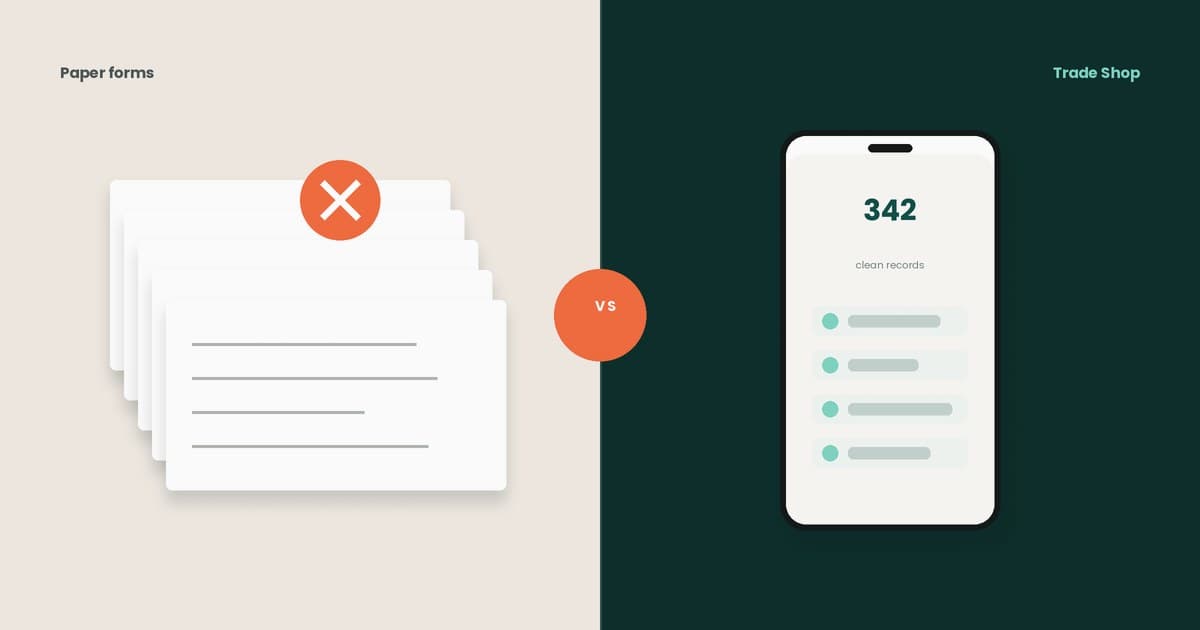
On the Monday after a fair, somebody on your team sits down with a bowl of business cards and a clipboard of forms and starts typing. It usually takes most of a day, and a share of the entries turn out to be unreadable, incomplete or invented.
By Wednesday, when the list is finally clean, the visitors have been home for four days and have forgotten which of the four hundred stands you were.
Paper is not stupid. It is just slow in a way that costs money at the far end.
Paper is still the default, and that is worth stating plainly
According to Trade Show PRO's 2026 statistics round-up, 46% of exhibitors still rely on manual processes — paper forms, handwritten notes and business cards. This is not a fringe habit. It is close to half the floor at any given fair, and the reason is not ignorance. Paper is cheap, it always works, and everyone already knows how to use it.
The same round-up reports that 78% of exhibitors who moved to digital lead capture say they would never go back to paper, and that digital tools generate three to four times more leads than manual methods. Take the second figure carefully — it is a comparison of methods across many kinds of exhibitor, not a guarantee about your booth. But the direction is consistent, and it matches what the failure modes below would predict.
The six ways paper loses leads
Handwriting. A stranger writing their email on a clipboard while standing up, in a hall, with someone waiting behind them, produces characters that are a coin flip. Is that an rn or an m? A 1 or a 7? A Gmail or a Gmial? You will never know, because the only person who could tell you is the person you cannot reach. Every ambiguous character is a lead you paid booth money for and cannot use.
Transcription cost. Somebody has to type it. Call it an example calculation: 400 forms, a minute each with the squinting and the double-checking, is nearly seven hours of a salaried person's week. That is a real line item that never appears in the exhibition budget, and it is the reason the list gets typed "next week" rather than that night.
Lost sheets. Clipboards migrate. Pages get used as coasters, get filed under the table with the cable ties, go home in a rep's bag on the day they hand over to the night shift. Nobody ever counts what was lost, because the count was on the sheet.
No timestamp. A paper form tells you nothing about when it was filled. You cannot tell your morning crowd from your evening crowd, cannot see which day carried the traffic, and cannot tell whether the giveaway on day four actually moved anything. Every measurement question you might want to ask afterwards is unanswerable. That is a problem if you care about the booth numbers that matter.
No consent record. This is the one that has changed since 2023. Under the Nigeria Data Protection Act, consent for direct marketing must be freely given, specific to each purpose, informed, unambiguous and affirmative — and it has to be demonstrable. A stack of names in a bowl is not evidence of anything. If somebody complains to the NDPC that you called them without permission, "they dropped a card" is a weak position. Penalties run up to ₦10m or 2% of annual gross revenue for a data controller of major importance. We go through what to put in front of a visitor in Is your booth raffle legal? — and none of this is legal advice.
Delay. This is the expensive one. Trade Show PRO reports that companies contacting leads within 24 hours are six to nine times more likely to convert than those who delay, and that up to 80% of trade show leads never receive any follow-up at all. Paper puts a mandatory typing job between the fair and the first call, and that job always slips. The window closes while the data is still in a bag. Our 72-hour follow-up plan assumes you have a usable list on the night, which is exactly what paper cannot give you.
Paper does not lose leads at the booth. It loses them on the Monday, in a spreadsheet, while somebody guesses at a phone number.
What paper genuinely does better
Now the other side, because it is not nothing.
Paper needs no battery. At a ten-day fair at Tafawa Balewa Square, where the generator does what generators do, a clipboard is the only thing on your stand that is guaranteed to be working at 3pm.
Paper needs no network. No MiFi, no data bundle, no dead spot behind the pillar. Trade Shop needs a connection to load and submit; so does any browser-based tool. Paper does not care.
Paper needs no phone from the visitor. Some people will not scan a QR code from a stranger. Some are on a phone with 4% battery. Some hand their phone to a child while they talk. A form on a clipboard removes the entire question of whose device this is happening on.
And paper is instant to deploy. No campaign to build, nothing to test, no account. If your booth decision happened yesterday, paper is what you can have today.
The sensible conclusion is not that paper is obsolete. It is that paper is a fallback, and a fallback is exactly what it should be — kept under the table for the twenty minutes when the network is down, not run as the primary system for ten days.
| Paper forms / card bowl | Trade Shop | |
|---|---|---|
| Cost | Printing and a clipboard | from ₦10,000 for up to 3 days |
| Data entry | Someone types it afterwards | Visitor types it on their own phone |
| Legibility | Depends on handwriting | Typed, no transcription |
| Timestamp | None | Every lead entry recorded |
| Consent record | A signature at best, usually nothing | No dedicated marketing-consent field |
| Time to a usable list | Days | The list exists as it fills |
| Incentive for the visitor | A draw you promise later | Spin and prize on the spot |
| Prize control | Manual, invisible to the visitor | Prize limits and controlled probabilities |
| Works with no power | Yes | No |
| Works with no network | Yes | No |
| Needs the visitor's phone | No | Yes |
| Export | Retype it | Export participant records |
What we would actually run
Trade Shop as the main capture: QR code on the fascia and on the table, visitor scans, fills in their details on their own phone with no app to install, spins the branded wheel, and their record lands in your dashboard timestamped and readable. Prize limits keep the good item from walking out at 10am on day one.
A pad of paper under the table for the outages and for the visitor who will not scan. Type those in the same evening while the day is fresh — thirty entries is fifteen minutes, four hundred is most of a working day.
That combination gets you the reliability of paper without the Monday.
Frequently asked questions
How many leads do exhibitors lose to paper forms?
There is no single reliable number for losses, but Trade Show PRO's 2026 round-up reports digital tools generating three to four times more leads than manual methods, and that 78% of exhibitors who switched would never go back to paper. The mechanism is delay and illegibility, not one dramatic failure.
Is the business card bowl still worth doing?
As a prize draw entry it still pulls people in, but the bowl on its own gives you no consent record, no timestamp and no phone number for anyone who did not bring cards. Use the draw as the hook and capture the details digitally.
Do paper lead forms meet NDPA requirements?
They can, if the form carries a clear privacy notice and an affirmative, unticked consent box, and you keep the sheets. In practice most booth forms carry neither, and a bowl of loose cards carries no consent at all. This is not legal advice.
What happens to my leads if the network goes down at the fair?
Trade Shop needs a connection, so keep a paper pad as your fallback and enter those records the same evening. That is the one job paper should still be doing on your stand.
Get the list before you leave the hall
If your last fair ended with a bag of paper and a week of typing, run the next one differently. Set up a campaign, print the QR, and leave the venue with a clean, timestamped, consented list already exported. Launch a campaign — from ₦10,000 for up to 3 days, plus ₦1,000 per extra day.
Sources: Trade Show PRO — Trade Show Statistics 2026: 50+ Data Points Every Exhibitor Should Know · Nigeria Data Protection Commission · QRCodeChimp — Lead capture forms for events