
Two companies book stands in the same aisle at Tafawa Balewa Square. Same size, same ten days, roughly the same spend.
One goes home with 380 names, a phone number for each, and a note on what every person actually wanted. The other goes home with a bowl of business cards and a WhatsApp group nobody remembers joining.
The difference is almost never budget. It is a handful of decisions made weeks before the doors open.
Set the number before you sign the stand contract
Most exhibitors decide how much to spend, then hope for leads. Reverse it.
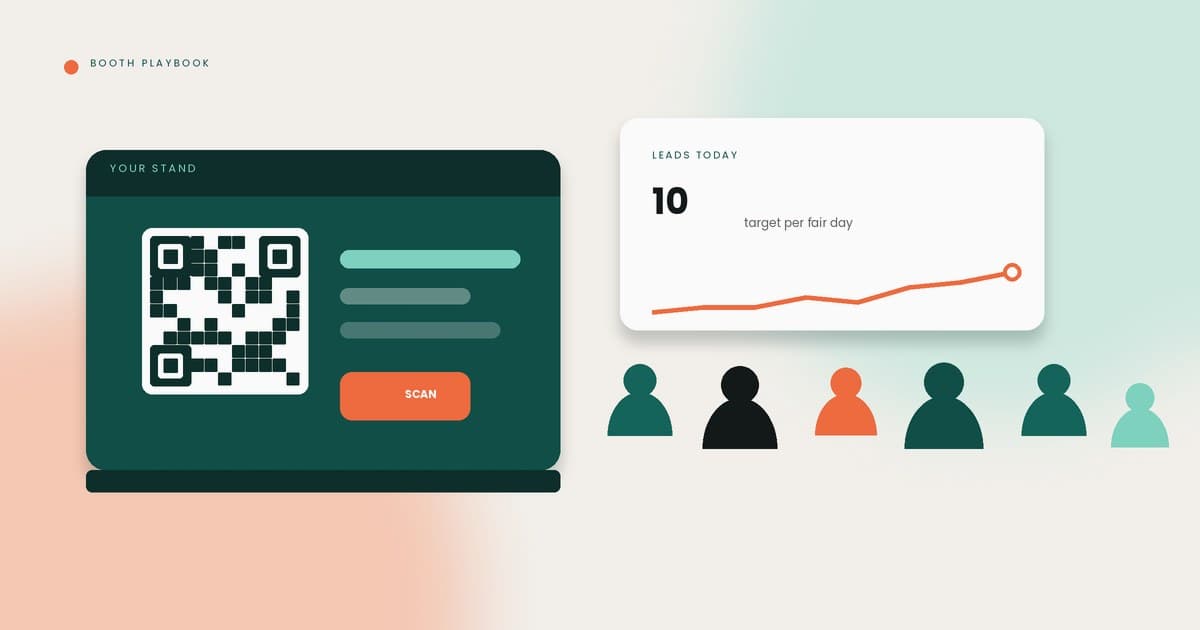
Here is an example calculation, not a benchmark. Your total fair cost lands at ₦900,000 once you have paid for stand, branding, staff, transport and power. Your average closed deal is worth ₦180,000. You close roughly one in twenty qualified leads. Five sales to break even means 100 qualified leads, which across ten days is ten a day, or about one an hour.
Ten a day is a target your staff can hold in their heads. "As many as possible" is not. Write the daily number on a card and tape it inside the stand where only your team can see it.
It also gives you a cost ceiling. According to Trade Show PRO's 2026 statistics round-up, trade show lead acquisition runs roughly $100 to $300 per prospect globally, against $400 to $600 for outbound sales leads. Fairs are meant to be the cheap channel. If your cost per qualified lead lands worse than your cold-calling cost, the booth is the problem.
You have about eight seconds, and most of them are spent walking
Trade Show PRO puts the average time an attendee spends at a booth at five to eight minutes, and the number of booths they visit at five to eight a day. Across a full fair day, fewer than ten stands get any real attention.
Everything before those five minutes is a walk-past. Call it eight seconds from the moment your stand enters someone's peripheral vision to the moment they have passed it. That is a rule of thumb, not a published figure, so time it yourself on day one. It is not enough to read your tagline, understand your product and decide to engage. It is enough to notice one thing.
A nice banner is not a reason to stop
The common Nigerian booth failure is a beautifully printed backdrop with the company name, a stock photo and four bullet points of services, staffed by two people behind a table. Nothing on that stand asks the visitor to do anything.
A reason to stop is a verb. Something is moving, something is happening to someone else, or there is a specific thing on offer that takes under a minute. Trade Show PRO reports that booths with interactive demos see two to three times longer engagement, and that gamified elements lift booth staff engagement by 35 to 40 per cent. The second number matters on day seven.
| What the standee says | What the visitor does |
|---|---|
| "Welcome to Acme Ltd, leading provider of logistics solutions" | Reads half of it, keeps walking |
| "Scan. Spin. Win free delivery for a month." | Stops, asks what the catch is |
| "Visit our website to learn more" | Nothing, ever |
| "Two spins left on today's ₦50,000 prize" | Stops, and looks for a queue |
Put the reason to stop at eye level, at the edge of your stand nearest the oncoming traffic, readable from three metres. Your company name can be smaller than you want it to be. The visitor will learn who you are in the next thirty seconds.
A prize you hand over before you have a phone number is a gift, not a lead.
Take the details first, always
This is the most expensive habit to fix. Somebody spins, wins a branded flask, and walks off while your rep is still looking for the pen. You paid for the flask and got nothing back.
The order is not negotiable: details, then spin, then prize. Trade Shop enforces it by design. The visitor scans the QR code, fills the form on their own phone, and only then does the wheel appear. No app install, no clipboard, no handwriting to decipher on Monday.
Trade Show PRO found that 46 per cent of exhibitors still rely on manual processes, that digital tools generate three to four times more leads than manual methods, and that 78 per cent of exhibitors who moved to digital capture say they would never go back to paper. If you are still running a bowl, read paper forms versus digital capture.
Collect it with proper consent. Nigeria's Data Protection Act 2023 requires consent that is specific, informed and affirmative before you market to someone, which we cover in the NDPA guide.
Four questions worth asking while the wheel spins
The spin takes a few seconds and the visitor is watching the screen, not you. That is free qualifying time. Trade Show PRO reports that lead scoring at the point of capture improves conversion by 38 per cent, and scoring only works if somebody asked something.
| Ask this | What the answer tells you |
|---|---|
| "What brought you to the fair today?" | Buyer, browser, or someone else's staff |
| "Are you buying for yourself or for a company?" | Deal size, and whether you are talking to the decision maker |
| "When would you actually need this?" | Whether they belong in this month's pipeline or next quarter's |
| "Which part of Lagos are you coming from?" | Delivery cost, service coverage, and a natural way to end the conversation |
Have your rep type a one-word tag into a phone note as the visitor walks away: hot, warm, or cold. Three seconds per person, and it turns an export of 380 rows into a call list.
The window is twenty-four hours
Trade Show PRO reports that up to 80 per cent of trade show leads never receive any follow-up at all, and that companies contacting leads within 24 hours are six to nine times more likely to convert than those who delay.
That is the whole game. A mediocre booth with same-day follow-up beats a brilliant booth whose leads sit in a spreadsheet until the following week. Before the fair starts, decide who is sending messages that evening and what they are sending. Our 72-hour follow-up plan has the hour-by-hour version and copyable templates.
Frequently asked questions
How many leads should I expect from a Nigerian trade fair?
It depends far more on your stand position and your reason to stop than on the fair itself. Set a target from your own economics, as in the example above, rather than from another exhibitor's number.
Do prize giveaways attract the wrong people?
Badly designed ones do. The prize decides the crowd, so a generic prize brings generic traffic. Design the grand prize so only a real buyer wants it, which we cover in prize wheel design.
What information should I collect at the booth?
Name, phone number, and one qualifying field that matters to your business. Every extra field costs you completions, so keep it to four or fewer.
Is a QR code better than a paper form at a Nigerian fair?
For most exhibitors, yes. It removes handwriting errors, works while your rep is talking to someone else, and gives you a clean export instead of a transcription job.
Build the booth around the capture, not the banner
Trade Shop turns booth attention into leads. Visitors scan, enter their details, then spin your branded wheel, and you get lead records and spin outcomes in the dashboard, plus a lead CSV export. It runs in the phone browser, so nobody downloads anything.
Launch a campaign — from ₦10,000 for up to 3 days, plus ₦1,000 per extra day.
Sources: Trade Show PRO — Trade Show Statistics 2026: 50+ Data Points Every Exhibitor Should Know