
The pitch for enterprise lead retrieval is genuinely good. Scan a badge, get a complete verified profile, tag the lead as hot, and watch it land in Salesforce before the visitor has left the stand.
Everything in that sentence depends on one thing that nobody mentions in the demo: the organiser has to issue scannable badges, and their registration system has to expose the data.
At Tafawa Balewa Square in November, that is not the world you are working in.
What the enterprise tier actually costs
All the pricing below is as reported in Lensmor's 2026 round-up of trade show lead retrieval apps, and it is worth reading in full if you are evaluating these seriously. Prices move, vendors renegotiate, and most of this category does not publish rate cards at all.
As reported there: Momencio runs around $100 per seat per month, billed annually, with a five-seat minimum — so the smallest viable commitment is five seats for a year, whether your fair lasts ten days or three. Webex Events is enterprise-licensed and cited in the $10,000+ per year range. Cvent LeadCapture comes bundled with Cvent packages, and critically it only works at Cvent-powered events. iCapture, which is part of Cvent, is a quote-based add-on. Blinq is usage-priced and does not publish figures. Popl has a free tier for digital cards but its event lead capture is quote-based. Mobly and vFairs are custom-quoted.
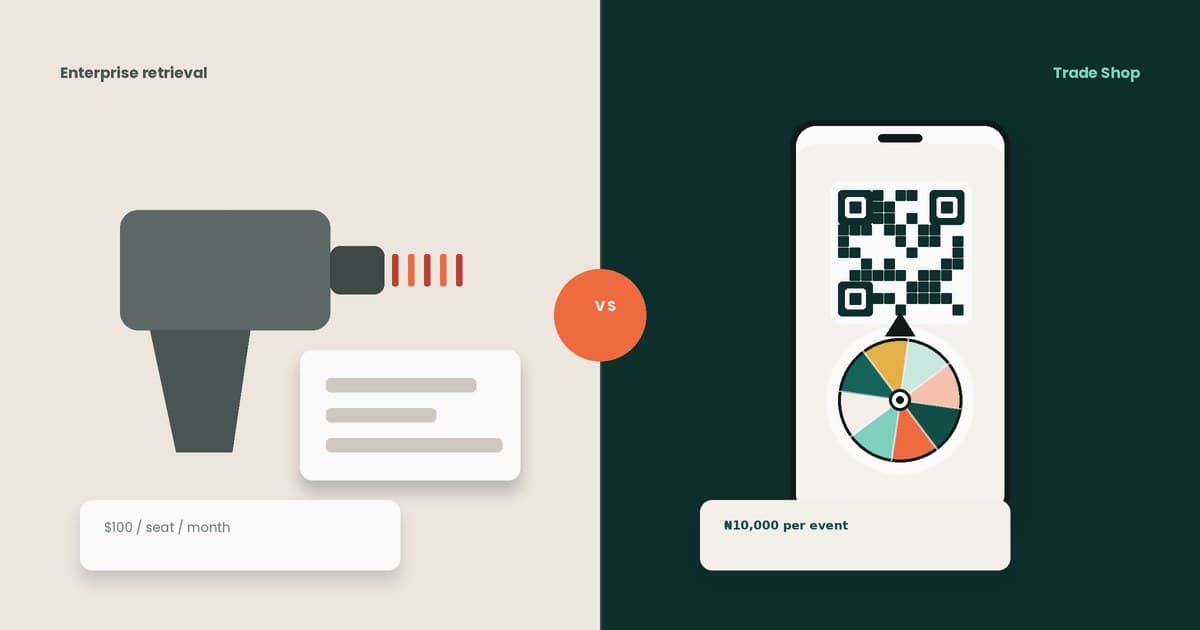
The pattern is per-seat, per-year, in dollars, sold to a company that exhibits at many events. Trade Shop starts at ₦10,000 for up to 3 days. We are not going to convert those figures for you, because the rate you get is not the rate we would quote. The comparison that survives FX movement is simpler: a single seat of a US lead-retrieval tool can cost more per month than a whole year of Nigerian fairs on Trade Shop.
The badge assumption is the real problem
Cost is the argument everyone expects. The structural one matters more.
Lead retrieval is badge-scanning software. It works because the organiser runs registration, prints a badge with a barcode or NFC chip, and licenses exhibitors to read it. When that chain holds, it is superb — you get a verified name, company, job title and email in under a second, with no typing and no misspelling.
When it does not hold, the tool has nothing to read. And across the Nigerian fair calendar it mostly does not hold. Plenty of exhibitions here run on gate entry, hand-written passes, or a badge that carries a name and a logo and nothing machine-readable at all. There is no exhibitor lead-retrieval licence to buy because there is no registration database to sell access to.
Most of these tools do offer a manual or business-card-scan fallback, and some scan QR codes on badges where the organiser supports them. But buying a badge scanner for a fair with no scannable badges is buying a fallback at the price of a full system.
Lead retrieval reads a badge the organiser issued. Trade Shop creates the thing to scan itself, which is why it does not care what the organiser does.
Trade Shop inverts the direction. The QR code belongs to you, sits on your fascia and your counter, and the visitor scans it with their own phone. It works at Landmark Centre, at a church-hall pop-up, at a mall activation and at a fair with no registration system whatsoever, because there is nothing to integrate with.
What enterprise tools genuinely do better
This is the part a fair comparison has to include, and Trade Shop loses most of these rows outright.
CRM sync. The serious lead retrieval tools sync captured leads into a CRM rather than leaving you with an export — Lensmor's round-up lists CRM integration for Blinq, and real-time CRM sync for iCapture. Trade Shop does not integrate with any CRM. You export participant records and import them yourself, or send from your own tool.
Offline mode. Several of the enterprise tools queue captures locally and sync when the connection returns — Lensmor's round-up lists offline capture for iCapture, Cvent LeadCapture, Blinq and vFairs — which, in a metal-roofed hall with 50,000 people on the same masts, is a serious advantage. Trade Shop has no offline mode. It needs a live connection to load and to submit.
Qualification workflows. Custom qualifying questions per rep, hot/warm/cold tagging, notes and voice memos attached to a lead, and scoring at the point of capture. Trade Show PRO's 2026 round-up reports that lead scoring at the point of capture improves conversion by 38%, and that is precisely the workflow these tools are built around. Trade Shop captures the details the visitor enters and the spin outcome. That is it.
Multi-event programmes. If you exhibit at fifteen events a year across three continents, you need consolidated reporting, per-event attribution, team seats and permissions. Trade Shop has campaign history across active, completed and draft campaigns, but no team seats and no API.
Booth presentation tools. Momencio and similar are as much iPad presentation systems as capture tools — content decks, engagement tracking on what the visitor viewed, follow-up material sent from the stand. Trade Shop is not that.
If any three of those are load-bearing for your team, buy the enterprise tool. It is not overpriced for what it does; it is priced for a customer with a different problem.
| Enterprise lead retrieval | Trade Shop | |
|---|---|---|
| Pricing model | Per seat, per year, in dollars — much of it quote-based (as reported by Lensmor, 2026) | from ₦10,000 for up to 3 days |
| Smallest sensible commitment | Momencio: five seats, billed annually (as reported) | One event |
| Needs organiser-issued scannable badges | Usually yes — Cvent LeadCapture only works at Cvent-powered events (as reported) | No |
| Who scans | Your rep scans the visitor | The visitor scans your code |
| Hardware | Scanner or a dedicated device | The visitor's own phone, no app install |
| CRM integration | Yes | No — export and send from your own tool |
| Offline mode | Commonly yes | No |
| Lead scoring and qualification | Yes | No |
| Incentive built into capture | No | Spin the wheel, details captured first |
| Prize rules | Not applicable | Prize limits and controlled probabilities |
| Multi-event programme reporting | Yes | Campaign history only |
| Best for | Global exhibitors on badge-issuing circuits | Nigerian booths, pop-ups and activations |
The honest positioning
Trade Shop is not a cheaper Cvent. It is a different category of thing.
Lead retrieval solves the problem of a visitor who already wants to talk to you and is holding a badge you can read. Trade Shop solves the problem of a visitor who is walking past and has no reason to stop. One is a capture instrument for a qualified conversation; the other is an incentive that produces the conversation in the first place.
That distinction shows up in the failure mode. An enterprise tool with no badges to scan is an expensive manual form. A prize wheel at an event where everyone is already pre-qualified and warm is a distraction from selling.
Pick by which problem you have. If you exhibit at Nigerian fairs, at prices set in naira, with organisers who issue paper passes, the badge question answers itself. And if what you actually need is a comparison against the free options, we have written those too: Google Forms and paper forms.
Frequently asked questions
What is the cheapest lead retrieval app for trade shows?
Most of the category is quote-based, so there is no clean answer. Of the published figures in Lensmor's 2026 round-up, Momencio is reported at around $100 per seat per month on an annual, five-seat minimum. Trade Shop starts at ₦10,000 for up to 3 days with no seat count.
Do I need badge scanning at a Nigerian trade fair?
Usually not, because most Nigerian fairs do not issue machine-readable badges for exhibitors to scan. Without that, a badge-scanning tool falls back to manual entry, which is what you were trying to avoid.
Does Trade Shop integrate with Salesforce or HubSpot?
No. Trade Shop has no CRM integrations and no API. You export participant records and import or send them from your own tool — which is a real limitation, not a positioning choice.
Is Trade Shop an alternative to Cvent LeadCapture?
Only in the sense that both end with leads in a list. Cvent LeadCapture is badge retrieval at Cvent-powered events; Trade Shop is a QR and prize-wheel capture experience that works at any booth regardless of organiser.
Run one fair on it and compare the list
The fastest way to settle this is not a feature table, it is one event. Set up a campaign for your next fair, put the QR on the fascia, and see how the exported list compares with whatever you used last time. Launch a campaign — from ₦10,000 for up to 3 days, plus ₦1,000 per extra day.
Sources: Lensmor — 8 Best Trade Show Lead Retrieval Apps (2026) · Trade Show PRO — Trade Show Statistics 2026: 50+ Data Points Every Exhibitor Should Know