
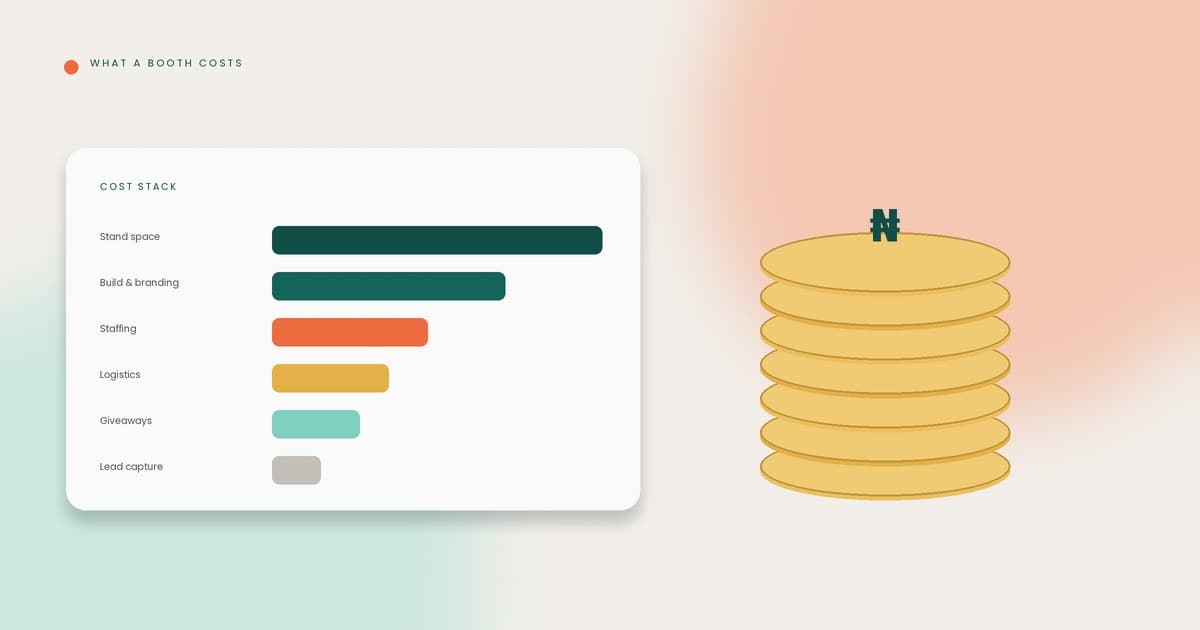
The stand fee is the number people quote each other. On most budgets we have seen laid out honestly, it is a minority of what the fair actually costs.
Ask a Nigerian exhibitor what they spent last November and you will get the space price. Ask them what the fair cost the business and you get a pause, because the answer includes a builder, a generator, four temporary staff, a fortnight of fuel, 600 branded pens and a week of somebody's life spent on follow-up they never finished.
Here is the whole bill, laid out.
The full line-by-line budget
Read this table as a worked example, not a price list. The naira ranges below are illustrative — they are there to show the relative weight of each line and to stop you forgetting one, not to tell you what any organiser or contractor will actually quote you. Real prices vary enormously by fair, by hall, by stand size, by year and by how early you book. Get your own quotes.
| Line item | Illustrative range (small–mid stand) | What determines it |
|---|---|---|
| Space rental | ₦250,000 – ₦1,500,000 | Size, hall, position, sector vs general fair, how early you booked |
| Stand build and branding | ₦150,000 – ₦1,200,000 | Shell scheme vs raw space; a built stand is a different order of cost |
| Power | ₦30,000 – ₦250,000 | Included load, extra kVA charges, whether backup generation is yours |
| Staffing | ₦120,000 – ₦900,000 | Number of days × people; temp staff, per diems, feeding, training time |
| Transport and logistics | ₦60,000 – ₦400,000 | Freight of stand and stock, daily runs, out-of-town flights and hotels |
| Samples and giveaways | ₦80,000 – ₦600,000 | Unit cost × volume; branded merchandise ordered late costs more |
| Lead capture | ₦0 – ₦150,000 | Paper is "free"; software, tablets or rented retrieval are not |
| Follow-up | ₦50,000 – ₦300,000 | Staff time to call and email; this is real money even when nobody invoices it |
Four notes on the rows people get wrong.
Space versus build. Shell scheme normally means walls, a fascia name board, a couple of lights and a socket. Raw floor space means you are hiring a contractor and the build can rival the space fee. Confirm which you are buying before the deposit — it is the single most common budgeting error, and one of the questions worth putting to an organiser in writing when you choose which fairs to book.
Days multiply everything. A ten-day fair like Lagos does not cost three times a three-day fair. It costs three times the staffing, three times the feeding, three times the transport, and one extra category of cost entirely: relief staff, because nobody works ten days straight well. Our Lagos International Trade Fair guide goes into what that run actually demands.
Follow-up is a budget line. It appears on no invoice, which is precisely why it never gets resourced. Somebody has to spend a week calling. If that week is not planned, it does not happen.
Lead capture is the cheapest line on the table and the one that decides the value of every other line. Spend ₦1.2m on a beautiful stand and capture names on a clipboard, and you have bought attention you cannot bank.
Every other line on the budget buys you attention. One line decides whether that attention turns into anything you can call on Monday.
The maths nobody does: cost per lead
Once you have a total, divide it. This is the number that tells you whether to go back next year.
Worked example — again, illustrative figures only. Say a mid-sized stand at a three-day Lagos sector fair comes to ₦1,400,000 all in. Say the stand captures 220 usable leads over the three days — names, phone numbers, and enough context to know who each person is.
₦1,400,000 ÷ 220 = roughly ₦6,400 per lead.
Now run it the way most stands actually perform. Same ₦1,400,000, but capture is a clipboard and a business card bowl, half the entries are illegible or bogus, and 90 records survive.
₦1,400,000 ÷ 90 = roughly ₦15,500 per lead.
Same stand. Same fair. Same money. The cost per lead more than doubled because of a decision about a clipboard.
Then apply the number that actually matters. Trade Show PRO's 2026 statistics round-up reports that up to 80% of trade show leads never receive any follow-up. If 80% of those 90 records are never called, the fair produced 18 followed-up leads, and the true cost per contacted prospect is around ₦78,000.
How that compares internationally
For contrast, the same Trade Show PRO round-up puts trade show lead acquisition at roughly $100–$300 per prospect, against $400–$600 for outbound sales leads.
Two things follow. First, trade fairs are a comparatively efficient channel worldwide — that is why serious companies keep exhibiting. Second, at any plausible naira exchange rate, the per-lead figures in the worked example above sit well below that international benchmark. Nigerian fairs are cheap for the exposure they give you. The exposure is not the problem.
The problem is conversion, and the round-up is specific about where it is won: companies that contact leads within 24 hours are 6–9x more likely to convert than those who delay, and lead scoring at the point of capture improves conversion by 38%. Both of those are free. Both of them are decided by how you capture, not how much you spend on the stand.
Which is why the sanest way to think about a Nigerian trade fair budget is this: the stand is the fixed cost of getting in the room, and everything that improves your return happens in the last two lines of the table. Fix those first. The 72-hour follow-up plan is where that work starts.
Frequently asked questions
How much does it cost to exhibit at a trade fair in Nigeria?
It varies far too widely for a single answer — the space fee alone can range from a couple of hundred thousand naira to several million depending on fair, size and position. Budget for space, build, power, staffing, logistics, giveaways, lead capture and follow-up, and get written quotes for each.
Is the stand fee the main cost of a trade fair?
Usually not. Once build, staffing, power, logistics and follow-up time are counted honestly, space is typically a minority of total spend. Work out your own split rather than assuming a ratio.
What is a good cost per lead at a Nigerian trade fair?
Work out your own baseline before judging it: total fair spend divided by usable, contactable leads. Compare it to what a lead costs you through your other channels, and remember that international benchmarks put trade show leads at roughly $100–$300 per prospect, according to Trade Show PRO's 2026 round-up.
How can I reduce the cost of exhibiting?
Book early for better space at better rates, share transport and staffing across a smaller stand, cut giveaway volume rather than giveaway quality, and above all improve capture rate — the cheapest way to halve your cost per lead is to double the number of leads you actually keep.
Cut your cost per lead before you cut your stand
You can shave a hundred thousand naira off the build and nobody will notice. Doubling the number of usable leads from the same stand changes the entire economics of the fair. Trade Shop starts at ₦10,000 for up to 3 days: a QR code on your stand, a branded prize wheel, visitor details captured before the spin, and a dashboard of leads and outcomes, plus a lead CSV export.
Launch a campaign — from ₦10,000 for up to 3 days, plus ₦1,000 per extra day.
Sources: Trade Show PRO — Trade Show Statistics 2026 · 10times — Trade shows in Nigeria