
You can spot the Google Form booth from ten feet away. A tablet on a stand, a laminated sign with a shortened link, and a rep saying "please just scan and fill" to people who are already walking.
It works. Sometimes it works well. Google Forms is free, it is flexible, and a marketer with fifteen minutes can build a lead form before the crate is unpacked.
The question is not whether Google Forms is a good tool. It is whether a free-standing form is the right instrument for the thirty seconds a stranger will give you.
What Google Forms genuinely does better
Start with the honest list, because it is longer than most comparison posts admit.
It costs nothing. Any Google account can build as many forms as it likes and collect responses straight into Sheets, within the storage a free account already gives you. For an SME founder who has just spent most of the marketing budget on booth space and a pull-up banner, zero is a real number.
It is completely flexible. Logic branches, dropdowns, validation rules, whatever qualification question your sector needs — plot size, herd count, LGA of operation. And you can change it at lunchtime on day one when you realise nobody understands question four.
The data lands somewhere useful. Responses flow straight into Google Sheets, which is where most Nigerian sales teams already live. No export step, no CSV, no waiting.
And it is familiar. Nobody on your booth team needs training. That matters more than feature lists at 4pm on day three.
The problem is not the form. It is the stranger.
Trade Show PRO's 2026 statistics round-up puts the average attendee at five to eight minutes in a typical booth, visiting roughly five to eight booths a day. That is the entire budget you are competing for, and most of it goes on looking, not typing.
A blank form is a request. It asks a stranger to spend attention with no return. The visitor's internal maths is simple: what do I get for my number, and how likely is it that somebody calls me tomorrow trying to sell me something.
The same round-up reports that booths with interactive demos see two to three times longer engagement. The form is not the draw. The reason to fill the form is the draw.
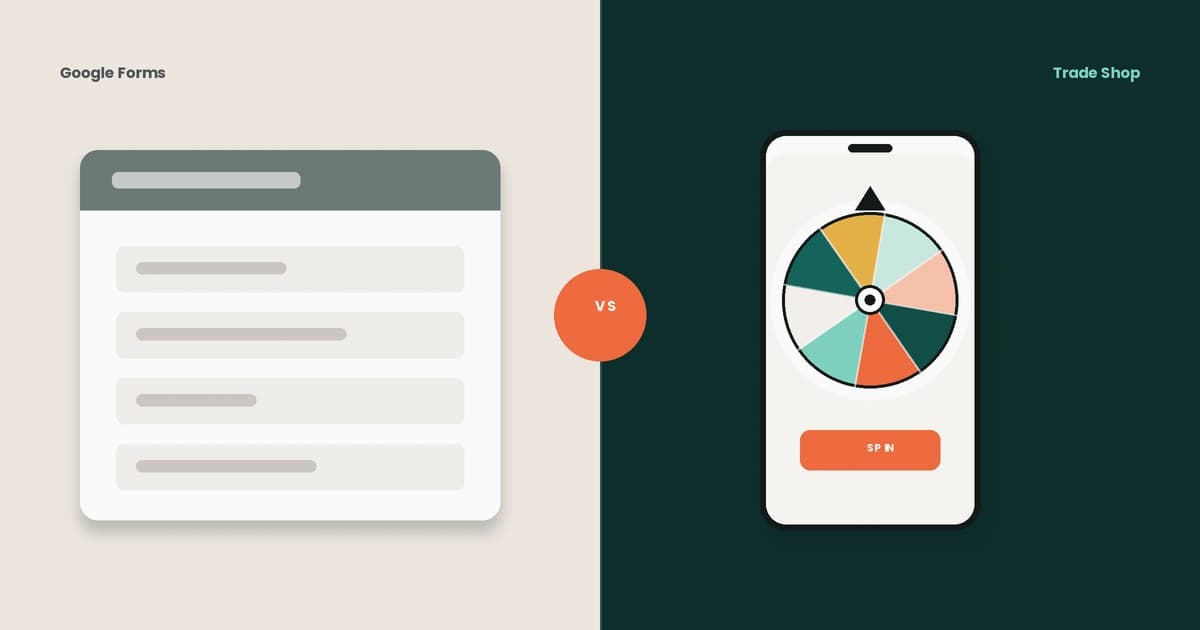
Trade Shop's design sits on that point. The visitor scans a QR code, fills in their details on their own phone with no app install, then spins your branded wheel for a prize. Details are captured before the wheel turns, so the incentive does the work the form cannot do alone.
A form asks a stranger for something. A wheel offers them something and asks for details on the way in.
Incentives, and why bolting one onto a form goes wrong
You can absolutely run a giveaway on a Google Form. Plenty of booths do. The mechanic usually goes: fill the form, we draw a winner on Friday, we will call you.
Two things break. The reward is delayed, so it barely functions as an incentive at the moment of decision — the visitor has to trust a promise from a company they met sixty seconds ago. And the draw happens off-stage, in a spreadsheet, where nobody sees it. A booth needs spectacle to interrupt a walking crowd, and a spreadsheet is not one.
Some teams run a spinner app next to the form instead. That splits the flow across two tools and two devices, and introduces the queue problem — one wheel, one person at a time. We covered that in Trade Shop vs Wheel of Names and free spinner apps.
Prize control is the row nobody thinks about until day two
Google Forms has no concept of a prize. No stock limit, no probability weighting, no cap. Drawing manually, you control the outcome completely — but slowly, and the visitor sees none of it.
Trade Shop handles prizes as rules: set the segments, cap how many of each prize can go out, and set controlled probabilities so the good item does not leave in the first hour. That is what stops a ₦50,000 hamper going to the second person through the door on day one of ten. Our prize wheel guide covers what to put on each segment.
Data quality, consent and what you actually export
Both tools capture typed data on the visitor's own device, so both avoid the handwriting disaster that afflicts paper forms and the business card bowl. Both timestamp entries. Both export.
Where they differ is what the record contains. A Google Form gives you the answers. Trade Shop gives you the answers plus the campaign context — which event, which scan, what the person spun, whether they won. Whether that matters depends on whether you run more than one fair a year.
On consent, neither tool is automatically compliant. Under the Nigeria Data Protection Act 2023, consent for direct marketing must be freely given, specific, informed and affirmative, and pre-ticked boxes do not count. Trade Shop currently has no dedicated marketing-consent field. See our NDPA post for what to put on the screen. Not legal advice.
Offline risk cuts both ways
Neither tool saves you when the network dies. A Google Form needs a connection to load and to submit. So does Trade Shop. Neither has an offline mode, and we are not going to pretend otherwise.
The mitigation is the same for both: a MiFi with two SIMs, and a rep who knows to take a name and number on paper when the bars vanish. Assume it happens at least once in a ten-day fair.
| Google Forms | Trade Shop | |
|---|---|---|
| Cost | Free | from ₦10,000 for up to 3 days |
| Setup time | 15 minutes, no help needed | Build a campaign, set prize rules, print the QR |
| Will a stranger stop? | Only if your rep sells it | The wheel is the reason to stop |
| Incentive built in | No — you bolt one on | Yes, spin happens after details are captured |
| Prize limits and probability | None | Prize limits and controlled probabilities |
| Branding | Header image and a colour | Branded spin experience |
| App install for visitor | None | None |
| Data destination | Straight to Google Sheets | Dashboard plus participant export |
| Campaign history across events | You manage the sheets | Active, completed and draft campaigns |
| CRM sync | No | No — export and send from your own tool |
| Offline mode | No | No |
| Best for | Sign-ups, surveys, budget-zero booths | Cold walk-up traffic that needs a reason to stop |
When Google Forms is the right call
Be honest about your booth. If people are already coming to you — a conference where you are a sponsor, a demo day, a launch where the room is warm and the audience knows the brand — you do not need to buy attention. A form is enough, and free is the right price.
Same if what you need is a survey, an RSVP, or feedback after a session. Those are Google Forms' home turf and no wheel improves them.
The case for Trade Shop is narrower: cold walk-up traffic, in a hall with hundreds of other stands, where the visitor has no reason to care yet and your problem is getting the first thirty seconds at all. That is the Lagos International Trade Fair problem, and it is a different problem from a form.
Frequently asked questions
Is Google Forms good enough for trade show lead capture?
For a warm audience that already wants to talk to you, yes. For cold hall traffic, the form gives a stranger no reason to stop, and that is the gap Trade Shop is built to fill.
Can I add a spin the wheel to Google Forms?
Not natively. You can run a separate spinner app beside the form, but you end up with two tools, two screens and no link between who entered and what they won. Trade Shop keeps capture and spin in one flow on the visitor's phone.
Does Google Forms work without internet at a trade fair?
No. A Google Form needs a connection to load and submit, and so does Trade Shop. Plan for a MiFi and a paper fallback either way.
How much does Trade Shop cost compared to Google Forms?
Google Forms is free. Trade Shop starts at ₦10,000 for up to 3 days, which covers the branded experience, QR access, prize rules and participant records. The question is what the incentive is worth on your specific floor.
Try it on one booth before you commit
If you are unsure, run both. Use a Google Form for the warm meetings your reps book at the stand, and run a Trade Shop wheel for the walk-up crowd, then compare how many usable numbers each produced. One fair is enough to settle it. Launch a campaign — from ₦10,000 for up to 3 days, plus ₦1,000 per extra day.
Sources: Trade Show PRO — Trade Show Statistics 2026: 50+ Data Points Every Exhibitor Should Know · Nigeria Data Protection Commission