
There is a folder on somebody's desktop right now called FAIR LEADS FINAL.xlsx. It was last opened in November.
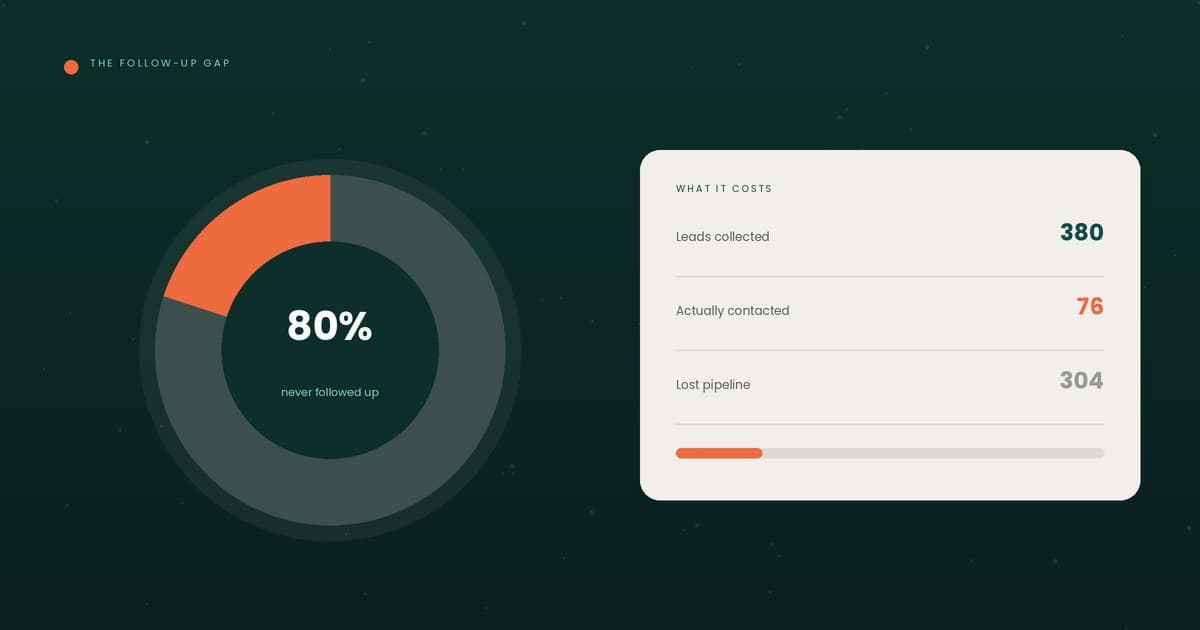
According to Trade Show PRO's 2026 round-up of trade show statistics, up to 80% of trade show leads never receive any follow-up at all. Not a late one. Not a bad one. None.
That number is usually quoted as a scolding. It is more useful as arithmetic. So let us do the arithmetic, in naira, with every assumption labelled.
The 80% figure, and what sits next to it
Trade Show PRO's 2026 round-up puts three findings side by side that only make sense together.
First: up to 80% of trade show leads never receive any follow-up. Second: companies that contact leads within 24 hours are 6–9x more likely to convert than those who delay. Third: trade show lead acquisition costs roughly $100–$300 per prospect, against $400–$600 for an outbound sales lead.
Read in sequence, those say something uncomfortable. Fair leads are the cheapest good leads most exhibitors will ever buy, they decay within a day, and four in five are never touched. You are not losing a marketing channel. You are paying for one and throwing most of it away.
A worked example, in naira
Everything in this section is an illustrative example, not research. The 80% figure and the 24-hour multiplier come from Trade Show PRO. Every other number below is an assumption I have picked to be plausible for a mid-sized Nigerian exhibitor, and you should replace each one with your own.
Assumption 1 — total booth cost: ₦850,000. Space rental, build and print, staff for the run, transport, power, and the small extractions that happen on a fair floor.
Assumption 2 — leads collected: 400. A busy booth over a multi-day fair.
Assumption 3 — close rate on a properly worked lead: 5%. That is one in twenty, which is generous for cold-ish traffic and stingy for a warm buyer segment. Pick your own.
Assumption 4 — average first order value: ₦250,000.
Now run it twice.
If all 400 leads are worked: 400 × 5% = 20 deals. At ₦250,000 each, that is ₦5,000,000 in first-order revenue against ₦850,000 of booth cost.
If the 80% dead-lead rate applies, only 80 leads are ever contacted: 80 × 5% = 4 deals. That is ₦1,000,000 against ₦850,000 of booth cost. You spent nearly a million naira to make slightly more than a million naira, and you will call the fair "okay, not great".
The gap between those two runs is ₦4,000,000 of destroyed pipeline from a single fair. Not lost to a competitor. Not lost on price. Lost to a drawer.
You did not have a lead generation problem. You had a lead generation success and a follow-up failure, and from the outside those look identical.
The cost-per-lead view is worse. ₦850,000 across 400 leads is ₦2,125 per lead — genuinely cheap. But you only worked 80 of them, so your real cost per worked lead is ₦10,625. And your cost per closed deal moves from ₦42,500 to ₦212,500. Same booth, same crowd, same staff. Five times the cost per customer, decided entirely after the fair ended.
Why follow-up actually fails
It is almost never laziness. In every post-mortem I have seen, the failure is one of four mechanical things.
The data is illegible. Trade Show PRO reports that 46% of exhibitors still rely on manual processes — paper forms, handwritten notes, business cards in a bowl. Handwriting on a clipboard at a loud booth produces phone numbers with ten digits, emails with a guessed domain, and company names nobody can read. A lead you cannot reach is not a lead. More on that in Trade Shop vs paper forms and the business card bowl.
Nobody owns the list. The booth had four people. The list belongs to all of them, which means it belongs to none of them. It sits with whoever happened to carry the folder home.
There is no deadline. "We'll follow up next week" is not a plan, and next week is when the 6–9x conversion advantage of a same-day contact has already expired.
There is no qualification. All 400 rows look identical, so working the list feels like cold calling. Trade Show PRO reports that lead scoring at the point of capture improves conversion by 38% — the point being at the point of capture, while the person is standing in front of you and the answer is free.
What actually fixes it
Fix the capture, and the follow-up problem gets much smaller on its own.
| Failure | The fix | What it changes |
|---|---|---|
| Illegible data | The visitor types their own details into their own phone | No transcription, no guessed domains |
| No owner | One named person owns the export before the fair opens | The list has an address on Monday morning |
| No deadline | First contact within 24 hours, no exceptions | Trade Show PRO's 6–9x conversion window |
| No qualification | One or two scoring questions on the capture form | Trade Show PRO reports 38% better conversion |
| Manual process | Digital capture — reported at 3–4x more leads than manual methods | More rows, and rows you can actually use |
None of that requires a CRM, an integration budget or a data team. It requires the details to arrive typed, in one file, with an owner and a date attached. Trade Show PRO reports that 78% of exhibitors who moved to digital lead capture say they would never go back to paper, which is about as close to unanimous as survey data gets.
If you want the operational version of this, what to do with your trade fair leads in the first 72 hours is the hour-by-hour sequence. If you want to know which numbers to watch instead of foot traffic, see six booth numbers that matter.
Frequently asked questions
How many trade show leads never get followed up?
Trade Show PRO's 2026 statistics round-up reports that up to 80% of trade show leads never receive any follow-up. The figure is an industry aggregate across markets, so treat it as a benchmark to beat rather than a prediction about your specific booth.
How quickly should you follow up on trade show leads?
Within 24 hours. Trade Show PRO reports that companies contacting leads inside that window are 6–9x more likely to convert than those who delay. Practically, that means the first message goes out the same evening, not the following Monday.
What is a good cost per lead at a trade fair?
Trade Show PRO puts trade show lead acquisition at roughly $100–$300 per prospect internationally, against $400–$600 for outbound sales leads. Nigerian booth economics differ, so calculate your own: total booth cost divided by leads captured, then divided again by the leads you actually worked.
Is it worth exhibiting if most leads go unworked?
That is the wrong comparison. The example above shows the same booth returning ₦1,000,000 or ₦5,000,000 depending only on what happens after the fair. Fix the follow-up before you conclude the fair was a bad channel.
Stop losing the list
Trade Shop captures lead details on the visitor's own phone before they spin your prize wheel, so what lands in your dashboard is typed, timestamped and exportable — a list you can work on Monday morning instead of decipher. Leads and spin outcomes sit in one place, per campaign. Launch a campaign — from ₦10,000 for up to 3 days, plus ₦1,000 per extra day.
Sources: Trade Show PRO — Trade Show Statistics 2026: 50+ Data Points Every Exhibitor Should Know