
Walk any Nigerian fair at 2pm on day six and you will see the same picture repeated down the aisle. Two staff seated behind a table, both looking at their phones, a bowl of business cards between them.
They are not lazy. They have been standing since 9am in a hot hall next to a generator, and nobody told them what to say or when they could sit down.
Booth staffing is the cheapest lever you have and the one most exhibitors leave to chance.
How many people you actually need
Trade Show PRO's 2026 statistics round-up puts the average time an attendee spends at a booth at five to eight minutes. Round it to six and add the gap between conversations, and one rep can properly handle about seven visitors an hour.
Work it back from your own target. Say, as an example, that you want ten qualified leads a day and roughly one conversation in three produces one: that is thirty conversations a day. That is over four hours of solid talking, which one person cannot sustain and two can manage while also eating and using the toilet.
| Stand | On the floor at all times | Total roster for a 10-day fair |
|---|---|---|
| 3m x 3m | 2 | 3, rotating |
| 6m x 3m | 3 | 4 to 5 |
| Corner or double-front stand | 4 | 6 |
One of those people must be someone who can answer a real commercial question. A stand staffed entirely by hired promoters can collect names but cannot convert a serious buyer who walks up at 11am with a purchase order in mind.
Rotate every ninety minutes
Nobody is good at this for six hours. Attention drops long before energy does, and the drop is invisible from inside it.
Run 90-minute shifts on the floor followed by a 20-minute break off-stand, out of sight of visitors. Stagger lunch so the stand is never below its floor number. On a ten-day fair, rotate people between days rather than running the same two throughout: day seven with fresh staff outperforms day two with tired ones.
Give whoever is on break a real elsewhere to go. Sitting on a chair at the back of your own stand eating rice is not a break, and it looks like exactly what it is.
Five body language rules
- Nobody sits. Put out one chair, at the back, for the person who is off shift, and take the rest away.
- No phones in hand on the floor. If your team needs the dashboard, one nominated person checks it, on break.
- No clustering. Stand apart, facing the aisle, never shoulder to shoulder in conversation with each other.
- Stand at the front edge, not behind the table. A table between you and the visitor is a counter, and people do not stop at counters they were not already heading for.
- No eating, no drinking anything but water, at the stand. Food at the stand ends conversations before they start.
Angle matters more than people expect. Standing square-on to the aisle reads as blocking. Standing at roughly 45 degrees, facing the direction people are arriving from, reads as open.
Two staff talking to each other is the strongest "do not approach" sign a booth can display, and it costs nothing to print.
Three openers that work, three that kill
You get about eight seconds as someone walks past. That is a working rule of thumb rather than a published figure, so time it on your own aisle. The opener is the whole of it.
These work:
- "Are you the one who buys the packaging for your business?" Qualifies and flatters in one line, and the answer routes the conversation immediately.
- "It takes ten seconds. Want to spin for free delivery for a month?" Names the time cost and the prize up front, which removes the thing they were actually worried about.
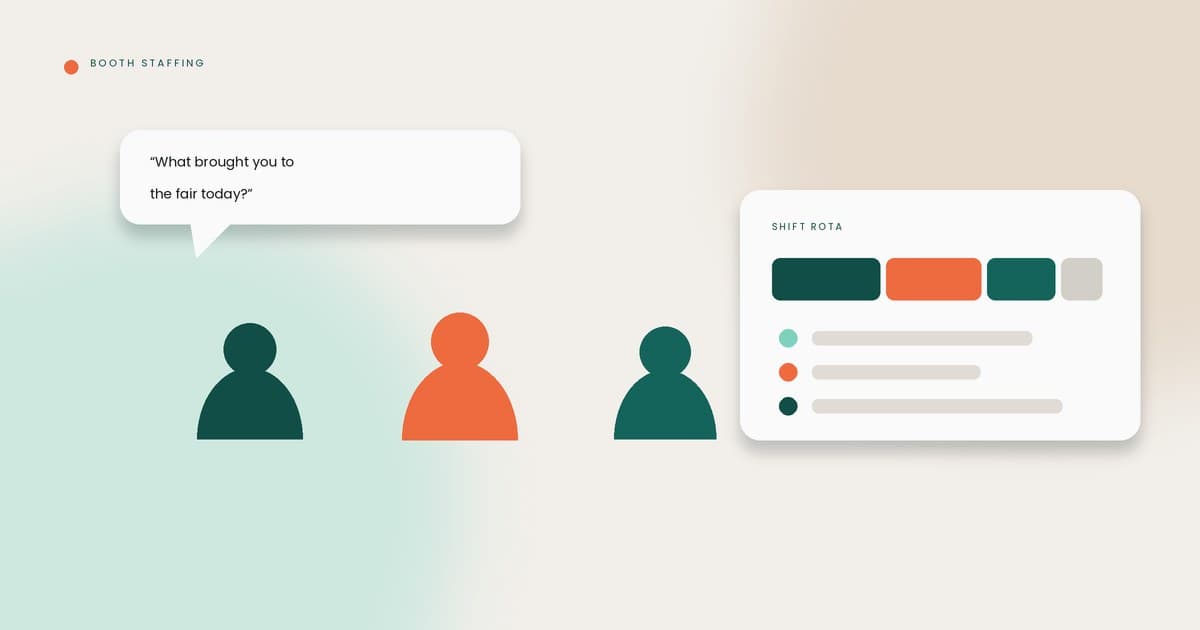
- "What brought you to the fair today?" Open, impossible to answer with one word, and their answer hands you the pitch.
These kill:
- "Can I help you?" Invites "no, just looking", which is a door closing. It is the most-used line at every fair in the country.
- "Do you know about Acme Ltd?" Makes the visitor feel tested, and most people escape a test.
- "We are the leading provider of integrated solutions for..." A monologue. The visitor is now waiting for a gap to leave through.
Have your team say the working opener out loud twenty times before the doors open. Written scripts do not survive a noisy hall; rehearsed ones do.
How to end a conversation without being rude
Two situations need this, and they need different scripts.
The good lead you have finished with: hand over the prize, confirm the next step out loud, and release them. "I have your number, I will send the price list this evening. Enjoy the rest of the fair." Take half a step toward the aisle as you say it. People follow movement.
The conversation going nowhere: cap it at four minutes. "Let me not take more of your time, there is a lot to see. You have got the voucher, use it before month end." Then turn toward the aisle and greet the next person. Every minute spent on someone who will never buy is stolen from someone who might.
Briefing a hired promo team
Promo staff are excellent at the part you cannot teach in a day, which is approaching strangers cheerfully for six hours. They are hopeless at the part you skipped, which is what your company does.
Give them one printed page before the fair, covering six things:
- One sentence on what you sell and who buys it.
- The opener, word for word.
- The one qualifying question and where the answer goes.
- Three things they must never promise: prices, delivery dates, stock availability.
- When to hand over to a company rep, and which person that is.
- The daily lead target and what the day's prizes are.
Then rehearse for fifteen minutes on site, out loud, before the doors open.
Be careful with per-lead bonuses. They reliably produce a spike in volume and a collapse in quality, because the fastest way to earn one is to enter a friend's number. Pay instead on qualified leads reviewed the next morning, or on the day's total across the whole team.
Trade Show PRO reports that gamified elements lift booth staff engagement by 35 to 40 per cent, which is a real effect on a long fair. A wheel gives a nervous promoter something to offer instead of something to explain, and that difference shows on day eight.
Frequently asked questions
How many staff do I need for a trade fair booth?
Two on the floor at all times for a standard 3m x 3m stand, rostered across three people so somebody is always on break. Scale to three or four for larger and corner stands.
How long should booth staff shifts be?
Ninety minutes on the floor, then twenty minutes off-stand and out of sight. Stagger breaks so the stand never drops below its minimum.
What should booth staff say to attract visitors?
A short qualifying question or a named, timed offer. Avoid "can I help you", which invites a refusal, and avoid any opener that starts with your company description.
How do I brief promo staff I have hired for the day?
One printed page with the opener, the qualifying question, what they must not promise, and who to hand over to, followed by a fifteen-minute out-loud rehearsal on site.
Give your team something to offer, not something to explain
Trade Shop turns the opener into an offer: visitors scan a QR code, enter their details on their own phone, and spin your branded wheel, so your staff spend their energy talking rather than transcribing. Everything lands in one dashboard for the evening's follow-up.
Launch a campaign — from ₦10,000 for up to 3 days, plus ₦1,000 per extra day.
Sources: Trade Show PRO — Trade Show Statistics 2026: 50+ Data Points Every Exhibitor Should Know